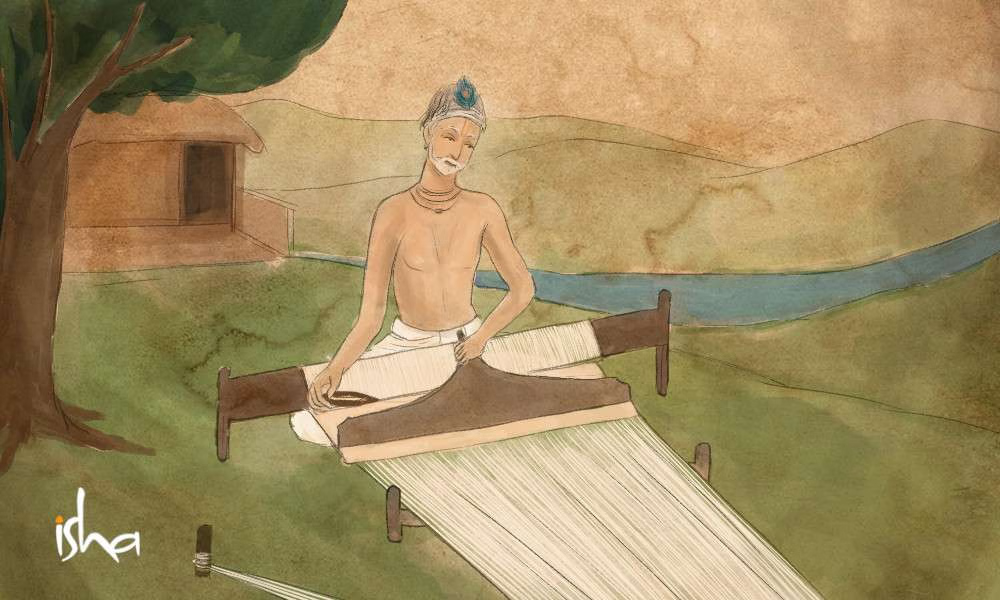
The Freedom of Praise: Kabir's Insight into Devotion
In the words of Kabir, "The pious people are not displeased with me; for they say I am praising God." This statement encapsulates a profound understanding of the relationship between the individual and the divine, suggesting that true devotion transcends societal expectations and norms. Kabir, a luminary of the bhakti movement, invites us to explore the essence of praise as an act of freedom, one that liberates the soul from the confines of dogma and allows for a genuine connection with the divine. This exploration is not merely an intellectual exercise; it holds the potential to transform our understanding of spirituality and our place within it.
At its core, Kabir's assertion challenges the conventional notions of piety and righteousness. It suggests that the act of praising God is not bound by the rigid frameworks often imposed by religious institutions. Instead, it is a spontaneous expression of love and devotion that resonates deeply within the heart. This perspective is particularly relevant in a world where spiritual expression can sometimes be stifled by fear of judgment or misunderstanding. Kabir's words remind us that true devotion is not about conforming to external standards but about nurturing an authentic relationship with the divine.
The image / the metaphor
The imagery in Kabir's quote evokes a sense of community among the pious, who find solace in the act of praise. The phrase "not displeased with me" suggests a harmonious relationship between the speaker and those who are traditionally seen as the guardians of spiritual propriety. The use of the verb "praising" indicates an active engagement with the divine, a dynamic relationship rather than a passive observance. This imagery invites us to envision a space where devotion is celebrated, rather than scrutinized, creating an atmosphere of acceptance and love.
Diving deeper into the metaphor, we can see that praise serves as a bridge between the individual and the divine. It is not merely an act of recitation or ritual; it is an expression of the soul's longing for connection. In this light, praise becomes a transformative force, capable of dissolving barriers and fostering unity. Kabir's assertion encourages us to recognize that the act of praising God is inherently liberating, freeing us from the shackles of judgment and allowing us to embrace our spiritual journey with authenticity.
In the speaker's tradition
Situated within the bhakti tradition, Kabir's perspective on praise reflects a broader understanding of devotion that emphasizes personal experience over institutional authority. Bhakti, which translates to "devotion," is characterized by an intimate relationship with the divine, often expressed through love, surrender, and selfless service. Concepts such as dharma, which refers to one's duty or path, and kenosis, the act of self-emptying, resonate deeply within this context. Kabir's approach to praise embodies the essence of bhakti, where the heart's yearning for the divine takes precedence over rigid adherence to religious norms.
In the context of Kabir's teachings, we can draw parallels to other spiritual texts that emphasize the importance of personal devotion. For instance, the *Bhagavad Gita* speaks of the significance of surrendering to God and recognizing the divine presence in all aspects of life. Similarly, the concept of *fana*, or annihilation of the self in the divine, echoes Kabir's sentiment that true praise arises from a place of deep connection and love. These texts collectively underscore the idea that devotion is a deeply personal journey, one that transcends the boundaries of tradition and invites us to explore the depths of our spiritual potential.
Living the teaching
In our modern lives, the teaching encapsulated in Kabir's quote can manifest in various ways. Consider a scenario where an individual feels compelled to express their spirituality outside the confines of organized religion. Perhaps they find solace in nature, feeling a profound connection to the divine while hiking in the mountains or meditating by a river. In this context, the act of praising God becomes a personal and liberating experience, free from the constraints of societal expectations. This individual embodies Kabir's insight, recognizing that their praise is valid and meaningful, regardless of external validation.
Another application of this teaching can be found in interpersonal relationships. Imagine a moment of conflict where two friends hold differing views on spirituality. Instead of allowing their differences to create division, they choose to engage in a dialogue that honors each other's perspectives. By praising the divine in each other, they create a space of understanding and acceptance, reflecting Kabir's assertion that true devotion fosters harmony rather than discord. In this way, the act of praise becomes a tool for reconciliation, allowing individuals to transcend their differences and connect on a deeper level.
A reflection
As we contemplate Kabir's profound insight, we are invited to reflect on our own relationship with praise and devotion. How do we express our love for the divine in our daily lives? Are there areas where we feel constrained by societal expectations or fear of judgment? In what ways can we cultivate a more authentic and liberated expression of our spirituality? These questions encourage us to explore the depths of our devotion, inviting us to embrace the freedom that comes from genuine praise.




Join the BrightStar Community
Stay connected with daily inspiration, event announcements, and community wisdom